




Last Updated:
September 21st, 2026

Walking is one of the most effective things you can do for your mental health in recovery. When you’re learning to manage difficult emotions without substances, get through cravings, rebuild routines, and just sleep properly, a daily walk helps with all those things. Walking costs nothing, requires no equipment, and the evidence behind it is strong.
What walking does to the brain
In the early days of recovery, your nervous system can feel stuck on high alert. When you walk, your body releases endorphins, and the stress hormone cortisol starts to drop. Within just a few minutes, this can help your nervous system settle.
Many people who develop an addiction also live with a co-occurring mental health condition such as depression or anxiety, but the research on walking for both shows it can help a lot.
A 2024 review of 75 trials, covering more than 8,600 people, found that walking reduces symptoms of both depression and anxiety. A separate review found that adults who did the equivalent of two and a half hours of brisk walking a week had a 25% lower risk of developing depression compared with those who did no activity at all. Even half that amount, around 75 minutes a week, was linked to an 18% lower risk.
If you’re doing no exercise at all, you don’t need to suddenly start doing twenty-mile hikes. Just three short walks a week build a habit, and can be enough to make a real difference to your mental health.
Walking to manage cravings and difficult moments
One of the hardest things about early recovery is knowing what to do when a craving hits. Cravings pass, but that’s hard to believe when you’re in the middle of one, and it feels overpowering. Exercise in recovery, including walking, helps reduce both how strong cravings feel and how long they last.
When you move, your body produces dopamine naturally, the same reward chemical that substances act on. Substances produce dopamine artificially in quantities the brain cannot sustain, which is why the effect wears off and the craving returns. Walking produces it at a level the brain can work with, and gives your mind something to focus on while the craving passes.
Most cravings peak within 15 to 30 minutes and then begin to ease. A 20-minute walk costs nothing and asks nothing of you except going outside. It gives you something purposeful to do instead of struggling for the cravings to pass. You go outside and start moving, and the craving slowly fizzles out.
And if you can feel a situation turning risky, walking away from it in the most literal sense is sometimes the right thing to do. Getting outside and moving puts real distance between you and whatever was pulling at you.
Make walking a part of your recovery routine
As you learn in rehab, recovery is built through small, repeated actions. A morning walk gives the day a clear start and gets you outside before anything else has had a chance to derail you. An evening walk gives you time to process the day and wind down before bed.
Building healthy coping strategies in recovery means knowing exactly what you’ll do when a craving hits. Having something specific is more useful than having a plan. Going for a walk is a specific action, and it really does work.
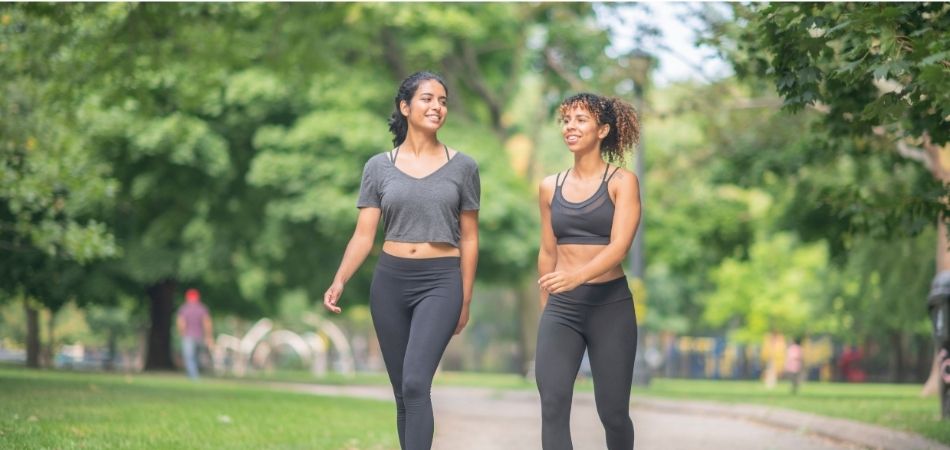
Walking with someone gives you company and movement at the same time. A friend, a family member, a neighbour, or someone else in recovery can all be good company on a walk. Conversation can come more easily when you’re walking side by side, as it takes some of the pressure off talking face to face about difficult things.
Walking somewhere green like a park or in the countryside reduces rumination, which is the kind of repetitive negative thinking that can be a real problem in early recovery. The change of scenery and the fresh air can change how your mind works in just a few minutes.
Walking in daylight, especially in the morning, helps set your body clock. Broken sleep is one of the most common problems in early recovery, but regular walking has been associated with better sleep. Better sleep supports mood, concentration and how well you can manage difficult feelings without needing drugs or alcohol.
Try mindfulness walking
Mindfulness walking means walking with your attention on what is happening around you right now. You notice the ground under your feet, the temperature of the air, the sounds around you, and what you see as you walk. It is simple, and it is one of the best ways to interrupt the anxious or craving thoughts that make early recovery exhausting.
Your attention will drift. When it does, bring it back to what is in front of you. Each time you do that, you are building the ability to stay present, which is really important for preventing relapse or personal struggles. The mind in recovery can pull towards regret about what happened before, or worry about what comes next. Mindfulness walking interrupts both, because it grounds you in one place at one moment.
Mindfulness walking is also effective for stress reduction in recovery. When you walk and pay attention to your surroundings, you make more time between a craving or negative feeling and your response to it. In recovery, that extra time breaks the link between a trigger and the drink or drug.
Get support for your recovery at Bayberry
Professional treatment, therapy and support networks are what addiction recovery is built on. But walking is something free and fun that you can add which can also give your recovery a real boost. Small, steady actions produce add up, week after week, and walking is one of the most accessible healthy habits.
At Bayberry, we support people through every stage of addiction recovery, from the first steps to long-term sober living. If you are thinking about getting help, or you are already in recovery and want more support, get in touch today for a free and confidential conversation.
(Click here to see works cited)
- Pearce, Matthew, et al. “Association Between Physical Activity and Risk of Depression: A Systematic Review and Meta-Analysis.” JAMA Psychiatry, vol. 79, no. 6, 2022, pp. 550–559. doi:10.1001/jamapsychiatry.2022.0609.
- Xu, Zijun, et al. “The Effect of Walking on Depressive and Anxiety Symptoms: Systematic Review and Meta-Analysis.” JMIR Public Health and Surveillance, vol. 10, 23 July 2024, article e48355. doi:10.2196/48355.


